

Archive note: Authorship attributed by the Prabhjot Singh archive. The original publication does not display a verified individual byline.
Chinese police stations in Toronto may sound strange. But if the latest reports in a section of the American media are any indication, there are three Chinese police stations in Toronto. There is one location in New York from where the Chinese police are operating.
A report in the New York Post said that China has opened dozens of “overseas police service stations” around the globe to monitor its citizens living abroad, including one location in New York City and three in Toronto.
Policing is normally a local or provincial subject. While in most of the democratic countries, the police are either with the local bodies – municipal councils – or with the provinces or State governments.
Some countries like India (Central Bureau of Investigation and National Investigation Agency) and Canada (Royal Canadian Mounted Police) have central agencies that assist local and provincial police forces.
The Chinese authorities have reportedly gone overseas and set up its police intelligence cells to keep watch on its nationals involved in trans-border crime. The presence of such police agencies, the report said, has been reported from 30 different countries.
There are instances when countries holding major events invite police forces from other friendly nations for help and assistance. In 2006 when Germany played host to the FIFA World Cup, police forces from some of the European countries travelled with supporters of their national teams to the venues of the FIFA World Cup to assist the local police in maintaining law and order. But setting up police stations overseas is an unprecedented phenomenon.
“These operations eschew official bilateral police and judicial cooperation and violate the international rule of law, and may violate the territorial integrity in third countries involved in setting up a parallel policing mechanism using illegal methods,” reads a report by Safeguard Defenders, a human rights watchdog, released earlier this month, the report said.
The report, titled “110 Overseas: Chinese Transnational Policing Gone Wild,” details China’s extensive efforts to combat “fraud” by its citizens living overseas, in part by opening several police stations on five continents that have assisted Chinese authorities in “carrying out policing operations on foreign soil.”
Europe is home to most of the police stations, with locations spread across the continent in places such as London, Amsterdam, Prague, Budapest, Athens, Paris, Madrid and Frankfurt. North America is also home to four of the stations, with three locations in Toronto and one in New York City. In all, there are 54 such stations in 30 different countries.
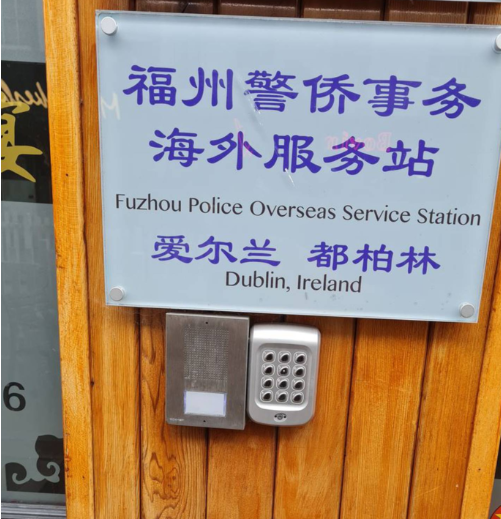
The report details how China has attempted to “combat the growing issue of fraud and telecommunication fraud by Chinese nationals living abroad,” running operations that have resulted in 230,000 Chinese nationals “being persuaded to return” to China “voluntarily” over the last year to face criminal prosecution.
The Chinese government has claimed that the stations provide vital services to its citizens living abroad, though the report notes that many of the services are those that would be traditionally carried out by an overseas embassy. Instead, the report argues that the stations have been used to enhance China’s overseas law enforcement capabilities in possible violation of international law.
The report also outlines the potential human rights abuses associated with the stations, including using harassment and intimidation methods, such as threatening the family members of the overseas citizens. The stations have also served as centers to spread Chinese government propaganda and monitor the behaviour and opinions of Chinese nationals.
“As these operations continue to develop, and new mechanisms are set up, it is evident that countries governed by the standards set by universal human rights and the rule of law urgently need to investigate these practices to identify the (local) actors at work, mitigate the risks and effectively protect the growing number of those targeted,” the report concludes.
Archived copy of the original page: Wayback Machine
No comments yet
Comments are closed.